
Ofcom's annual parcel survey found average customer satisfaction fell to 75% in 2026, according to a report by the trade publication ChannelX on 27 October 20261. It is the first decline in three years, after the average had held at 78% since 20231. Satisfaction ranged from 64% to 84% between individual parcel firms1. The survey measures how recipients experience deliveries, so it does not show which carrier is cheapest for a seller once failed deliveries and refunds are counted.
Ofcom's parcel satisfaction fell to 75% in 2026, the first drop in three years
ChannelX, writing on 27 October 2026, reported the fall in average satisfaction from Ofcom's fourth annual survey of parcel customers1. We have not seen Ofcom's 2026 publication itself, so the figures in this article rest on ChannelX's account of it1.
Who is affected: recipients, senders and the weakest carriers
The survey covers parcel recipients, meaning the people who receive packages1.
Evri and Yodel had the highest dissatisfaction scores, at 42% and 33% respectively1. Satisfaction with contacting or complaining to each firm about a delivery problem was 26% for Evri and 34% for Yodel, both well below average1. Amazon and FedEx both scored an average of 56% across all elements of the contact process1. ChannelX reports that Yodel and Evri were the worst performers for a fourth straight year1.
Across all operators, satisfaction with contacting parcel firms fell from 47% to 43%1. Seven in ten recipients (71%) reported a delivery issue in the past six months, up from 68% a year earlier1. The most common problems were delivery delays (32%), parcels left in an inappropriate location (28%), drivers not knocking loudly enough (25%) and not being given enough time to answer the door (20%)1. Disabled consumers and those with limiting conditions were more likely to report difficulties (76%) than people without such conditions (68%)1.
What changes for sellers and when: Ofcom is considering action but has not decided
Ofcom says it is concerned that a significant number of customers still experience problems, and that parcel operators can and should do more1. It says it is considering further action, including whether strengthened regulation is needed1.
No final regulatory decision has been announced in the sources we reviewed. Ofcom says it will provide further updates when it publishes its annual monitoring report on the postal market in December1.
The background is earlier regulation. In July 2022, Ofcom warned that parcel firms must get better at handling complaints and confirmed new measures to improve service standards2. ChannelX reports that Ofcom strengthened the rules on complaints handling and the treatment of disabled customers in 20231. The sources reviewed announce no change to carrier terms, fees or liability as a result of the 2026 figures.
Why the carrier ranking does not settle the cost question
The survey ranks firms on recipient satisfaction, not on what a seller pays. The sources retrieved give no carrier-level failed-delivery or refund rates, so the survey cannot show which carrier generates fewer failed attempts or refunds.
Evri questions the survey's method. Its spokesperson said Ofcom's data is 'unweighted by scale of carrier'1. Evri also cites third-party data from The Despatch Company showing that 99.4% of 1.3 million Evri parcels were delivered within seven working days1. These are Evri's claims. We have not checked them, and Ofcom has not made this finding.
Our view: the survey alone is not a sound basis for switching carriers. A small seller would need its own failed-delivery and refund data by carrier before drawing a cost conclusion.
What a failed delivery costs per parcel: an illustrative calculation
HubBox, a delivery vendor, estimates that a single failed first attempt costs £13.50 once redelivery transport, warehouse and admin time, and the customer-service contact are added4. Its estimates assume that 9.7% of home deliveries fail on the first attempt4. HubBox's figures are vendor estimates, not Ofcom or carrier data4.
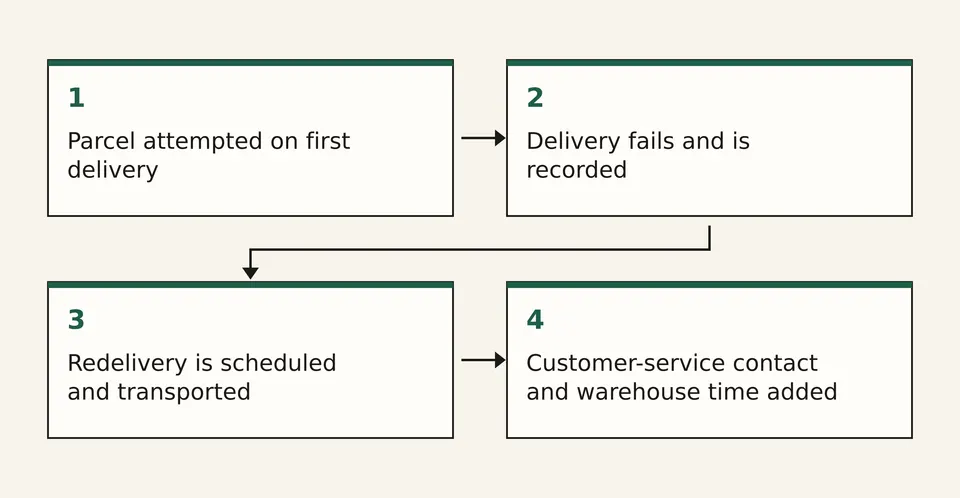
The table below uses those inputs. The £4.00 parcel price and the 10% return rate are our illustrative inputs, not sourced figures3. The return assumption that a return costs the same as an outbound parcel is also ours. Scale3PL notes that returned parcels can be charged and that the return trip is often billed at the full delivery rate, but it gives no figure for a return3.
| Cost component | Basis (source or assumption) | Per parcel (illustrative) |
|---|---|---|
| Returns | Illustrative: 10% of £4.00 parcels return; return costs the same as an outbound parcel (assumption) | £0.401 |
These figures exclude the value of the goods, packing and handling. A seller can rerun the sum with its own failure and return rates and its own carrier costs.
For a lockers-specific comparison of failed-delivery savings against fees, see Testing InPost lockers: when failed-delivery savings beat the fee.
What sellers should do now: compare all-in cost per delivered parcel
Our recommendations:
- Compare carriers on all-in cost per delivered parcel, including failed attempts, returns and surcharges, rather than on the base rate.
- Ask each carrier in writing for its failed-delivery and return fee schedules.
- Plan for seasonal and fuel surcharges. Scale3PL says most couriers add a peak charge from October or November to January, and every courier adds a fuel percentage on top of the base price3.
- Track your own failed-delivery and return rates by carrier for a few months before switching, since the public survey does not give you that data.
Scale3PL says couriers can change their charges at short notice, and its charge guide was last checked on 25 September 20263. Check current carrier price lists before you rely on any figure.
What is not yet known
- Ofcom's final decision on further action, which it has not announced.
- Carrier-level failure and complaint rates for UK parcels.
- Which firm scored 84%, the top figure in the 64% to 84% range1. The sources do not name it1.
- Whether the 2026 figures will be revised in Ofcom's December monitoring report1.
Questions readers ask
How far did parcel satisfaction fall in 2026?
According to ChannelX's account of Ofcom's survey, average satisfaction fell to 75% from 78%, the first decline in three years1.
Does the Ofcom survey show which carrier is cheapest for sellers?
No. The survey ranks firms on recipient satisfaction, not on what a seller pays, and the sources give no carrier-level failed-delivery or refund rates1.
How much does a failed delivery cost?
HubBox estimates £13.50 per failed first attempt, but this is a vendor estimate, not Ofcom or carrier data4.
What should sellers do before switching carriers?
Compare all-in cost per delivered parcel, request failed-delivery and return fee schedules in writing, and track their own failure and return rates by carrier for a few months3.