

Amazon's 300,000 holiday hires: what they mean for FBA peak fees
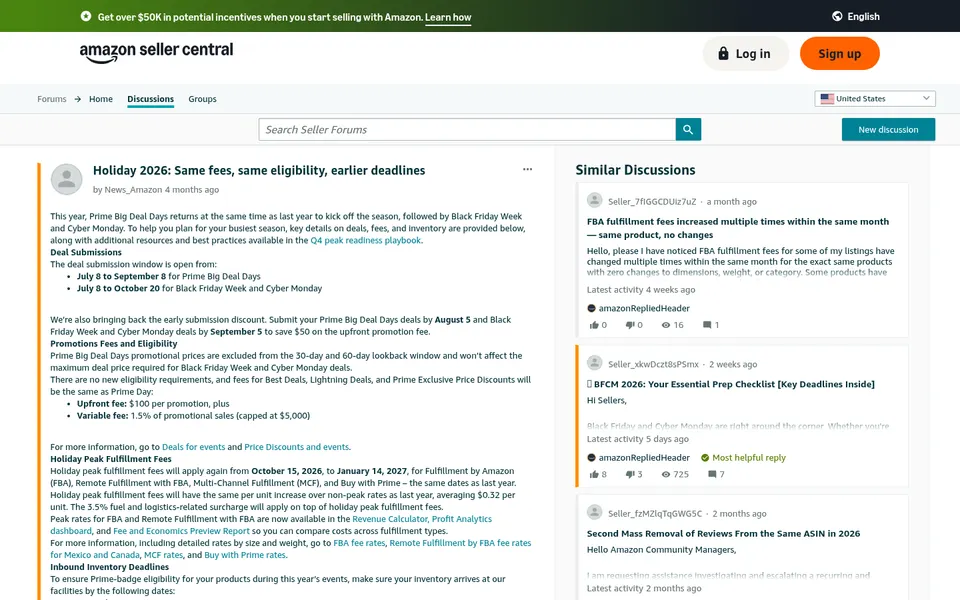
Amazon said on Tuesday 20 October 2026 that it aims to hire over 300,000 seasonal, part-time and full-time workers for its US operations this holiday season1,2. On the evidence reviewed, the hiring does not change the per-unit peak fee that Fulfilment by Amazon (FBA, Amazon's storage-and-shipping service for seller stock) charges from 15 October 2026 to 14 January 2027. That fee averages $0.32 per unit, the same as last year, with a 3.5% fuel and logistics surcharge on top3. Our reading is that the bigger effect for sellers is timing. Amazon has warned that seller capacity may tighten in November and December, so stock needs to arrive earlier3.
What did Amazon actually announce?
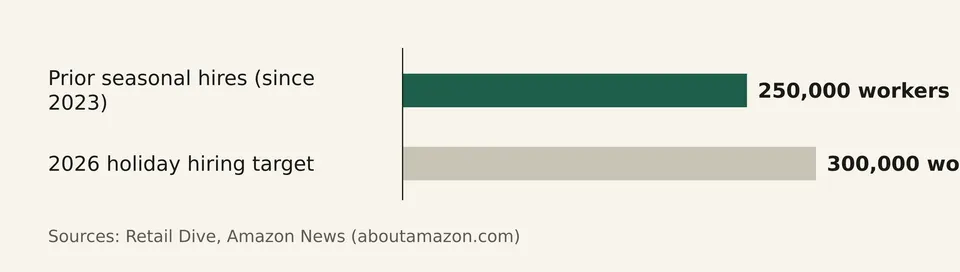
Amazon's announcement is about pay and benefits for its workforce. It does not mention seller fees or inbound capacity2. Retail Dive describes the target as a 20% increase on the 250,000 holiday workers Amazon has hired seasonally since 20231.


Amazon says seasonal employees earn an average of $20 an hour, and that new seasonal roles are posted weekly from October through December2. From 1 January 2027, seasonal employees who work at least 30 hours a week will get healthcare coverage from their first day2.
Retail Dive notes that retailers are bringing on fewer workers or staying quiet about their plans this season, which makes Amazon's figure stand out1. That is one publication's observation, not a market-wide dataset.
What the peak fee covers
The fee applies to units that leave an Amazon fulfilment centre between 15 October 2026 and 14 January 20273. The charge is set when a unit leaves the centre, not when the customer places the order5. It is also based on when the order leaves, not when inventory arrived. Stock delivered in the summer still pays the peak rate if it ships on or after 15 October6.
The average hides a wide spread. A small standard item under $10 has a peak fee of $2.62, against $3.77 for the same item over $505. A baby cot's non-peak fee of $10.21 rises to $11.25 at peak6. Apparel and dangerous-goods products follow separate rate structures4. The published tables are selected rates, so check the exact rate for each SKU in Seller Central5.
Separately, Amazon's standard US FBA fees rose by an average of $0.08 per unit on 15 January 20264. Unlike the seasonal peak fee, that is a standing, year-round increase4.
Where could extra hiring show up for sellers?
Amazon says its fulfilment centre teams focus on receiving holiday shipments in September and October, then shift to processing customer orders in November and December. Sellers may therefore see lower capacity limits at that time3. A secondary report of the same warning says seller capacity limits may decrease in November and December6.
Amazon says sellers can use Capacity Manager to bid for extra space in its fulfilment centres3. None of the sources reviewed publish what those bids cost.
Amazon also promotes Amazon Warehousing and Distribution (AWD), which stores extra inventory at lower rates and automatically replenishes fulfilment centres as needed3. Amazon says sellers who enrolled in AWD in the fourth quarter of 2025 saw an increase of over 13% in shipped units and a reduction of more than 30% in out-of-stock days3. These are Amazon's own figures, and the sources reviewed do not show how they were measured. Sellers who send stock through AWD and enable automatic replenishment to FBA keep paying the off-peak monthly storage rate through 31 October 20263.
Storage costs rise with time in the warehouse. A Novadata report cited by 595 Agency puts standard-size storage at $2.40 per cubic foot from October to December, against $0.87 from January to September5.
Our analysis: three scenarios for the next quarter
Our reading is that the hiring is a receiving and throughput signal, not a fee signal. The scenarios assume the published fee and capacity notices stay as they are.
- Base case: The peak fee stays at a $0.32 average plus the 3.5% surcharge, and capacity tightens after October3. The main risk is stockouts or delayed restocks rather than the per-unit fee.
- Upside: Receiving runs faster than Amazon's warning implies, so earlier shipments become sellable before the November shift. The per-unit fee is unchanged.
- Downside: Amazon revises the peak rate or the surcharge, or cuts capacity more deeply than it has warned. The per-unit cost then rises. No revision was published in the sources reviewed.
S5 says the surcharge is calculated against the fulfilment fee rather than the selling price, so check the base for your own SKUs. Actual figures depend on size tier and price band.
Signals to watch
The table lists published sources that would confirm or contradict the base case.
| Signal | What it would show | Where to check |
|---|---|---|
| Capacity limit notices for November and December | Whether the lower limits Amazon warned of3 appear in practice6 | Seller Central |
| Peak rates and the 3.5% surcharge | Whether the $0.32 average or the surcharge changes3 | Revenue Calculator, Profit Analytics dashboard and Fee and Economics Preview Report3 |
| Capacity Manager bids | Whether extra space is being priced up as capacity tightens (our interpretation) | Capacity Manager3 |
| Inbound cutoffs | AWD: 14 October. FBA: 21 October (minimal splits) and 28 October (Amazon-optimised splits)3 | Seller Central |
| Amazon Shipping peak window | A separate window of 25 October 2026 to 16 January 2027, per a Novadata tracker cited by 595 Agency5 | Amazon's Shipping fee terms; the tracker's dates are not confirmed by an Amazon page in the sources reviewed |
| End of peak window | Non-peak rates return on 15 January 20275 | Fee and Economics Preview Report3 |
The bottom line for FBA sellers
On the evidence reviewed, the 300,000 hiring figure does not change the per-unit FBA peak fee, which is a $0.32 average plus 3.5%3. Our view is that the workforce signal matters more for inventory timing. As of 26 October 2026, the AWD cutoff of 14 October has passed, and the 28 October cutoff for Amazon-optimised FBA splits is two days away3. If stock is not yet inbound, check whether it can meet that date.
For future planning, we recommend:
- Plan inbound volume for September and October.
- Check Seller Central capacity notices weekly.
- Recalculate per-SKU margins with the 3.5% surcharge before setting Q4 prices and ad targets3.
- Compare fee reports after 15 January 2027, when non-peak rates return5.
The sources were retrieved on 26 October 2026. Confirm all rates in Seller Central before acting.
Questions readers ask
Does Amazon's holiday hiring change the FBA peak fee?
On the evidence reviewed, no. The peak fee averages $0.32 per unit, the same as last year, with a 3.5% fuel and logistics surcharge on top3. Amazon's hiring announcement does not mention seller fees2.
When does the FBA peak fee apply?
It applies to units that leave an Amazon fulfilment centre between 15 October 2026 and 14 January 20273. The charge is set when the unit leaves the centre, not when the customer orders it5.
What should sellers do about capacity?
Amazon says its teams focus on receiving holiday stock in September and October, so sellers may see lower capacity limits in November and December3. Plan inbound volume earlier and check Seller Central capacity notices weekly.
Sources
- Amazon eyes 300K holiday hires Primary source
- Amazon is creating over 300,000 new US jobs this holiday season with increased pay and expanded benefits
- Holiday 2026: Same fees, same eligibility, earlier deadlines
- Amazon 2026 Holiday Peak FBA Fees: What Wholesale Sellers Should Budget For
- Amazon FBA Peak Fulfillment Fees 2026: What Changes
- Amazon Q4 2026 Deadlines & Fees: Is Your Inbound Strategy Peak-Proof?