

Walmart's published rules let AI shopping agents buy on Walmart.com under approvals set by the customer, but the sources publish no seller fee for agent-originated orders. The published seller fees that could be relevant are Walmart Marketplace's standard referral fees, which Walmart describes as ranging from 6% to 15%5. Whether those apply to agent orders is not stated, so the channel's profitability cannot be judged from published numbers as of 22 October 2026.
What has Walmart published about AI agents?
The published rules are written for agent operators and shoppers, not for sellers. Walmart's Agentic Access Terms, dated October 21, 2026, govern AI agents, the customers who authorise them, and any "Deployer", which the terms define as a company that offers, builds, configures, operates, supports or monitors an agent3.
Walmart announced Agent Profiles and the Walmart Agent Gateway on 21 October 20262. Agent Profiles are dedicated profiles for AI agents inside a customer's account, due "sometime in the next month"1. The Gateway is in beta "for companies and developers", and agents currently shop Walmart through a web browser2. The terms say the Gateway terms enable agents "to check out autonomously"3. The text of those Gateway terms (Addendum 1) was not in the copy we reviewed, so this article does not rely on it.
Retail Dive contrasts this with Amazon, which "has sought to stop agents from Perplexity and Meta from shopping through Amazon on behalf of customers"1.
Is there a seller fee on agent-originated orders?
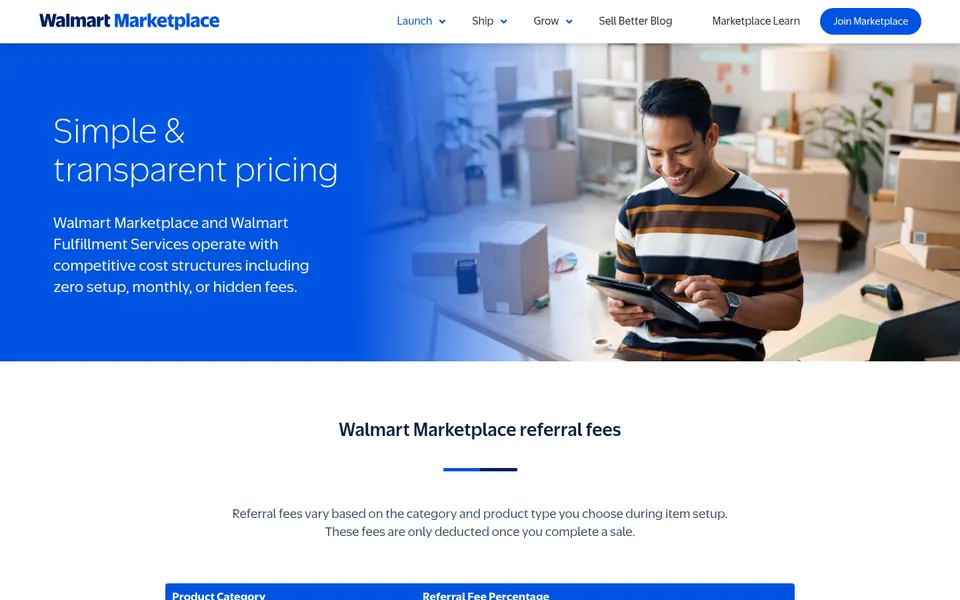
No seller fee for agent-originated orders is published in the sources we reviewed. The nearest published figures are Walmart Marketplace's standard referral fees, which Walmart says "vary by category and total sales price and range from 6% to 15%"5. The category table on the pricing page is wider. It lists 20% on the portion of a jewellery price up to $250, and 3% on the portion of a watch price above $1,5004. Walmart states that referral fees "are only deducted once you complete a sale", and that the total sales price "includes item price as well as shipping and handling, gift wrap and other charges"4.
Apparel is 5% for items at $15 or less, 10% from $15 to $20, and 15% above $204. Home, Kitchen, Decor & Garden is 15%4.
We checked the pricing and terms pages on 22 October 2026. Rules may change, so check the official Walmart Marketplace pricing page and the Walmart.com Help Center page for the Agentic Access Terms before relying on any figure.
How do shopper controls work?
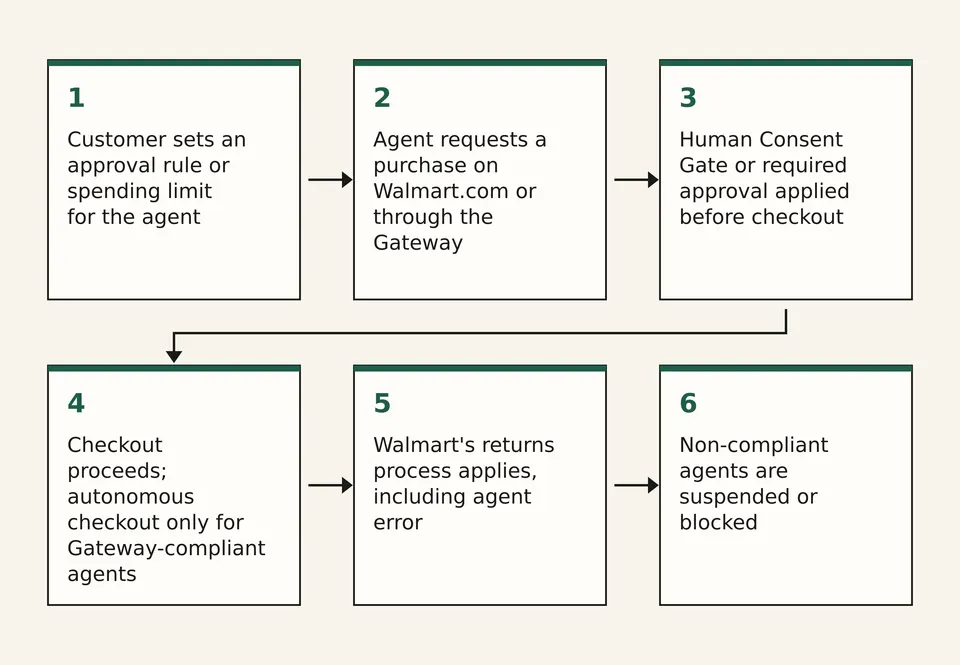
Customers must approve agent purchases by default, and Walmart "may require additional approvals even for purchases within an agent's spending limits"2. A customer can instead require approval for every purchase or set a spending limit, and Walmart's examples are $50, $100 or $2002.
Walmart says the prices an agent sees "are the same prices that a human would see on Walmart.com, with applicable offers and fees shown before purchase"2. Agents do not receive customers' payment-card information and cannot add or change payment methods2. The terms also define a "Human Consent Gate" as "a required point at which a human must personally review and take an affirmative action before an Agent-initiated step may proceed"3.
What is the step-by-step path for an agent order?
The published controls produce this sequence:
- Customer sets an approval rule or spending limit for the agent2.
- Agent requests a purchase on Walmart.com or through the Gateway2.
- Customer approval applies by default, and Walmart may require more approvals even within a limit2.
- Checkout follows. The terms say the Gateway enables agents to check out autonomously3.
- Walmart's returns process applies, including where an agent does not act as intended2.
- Agents that do not follow the terms are blocked from Walmart's site2.
How do the options compare?
| Criterion | Walmart Agent Gateway | Walmart direct agent access (browser) | Amazon (outside AI agents) | Walmart Marketplace standard referral |
|---|---|---|---|---|
| Access | Beta for companies and developers2 | Agents shop through a web browser2 | Sought to stop outside agents from shopping1 | Open to sign-up, subject to minimum qualifications5 |
| Checkout | Autonomous checkout enabled under Gateway terms3 | Customer approval by default2 | Not published | Not applicable |
| Seller fee on agent orders | Not published | Not published | Not published | Standard referral 6% to 15% by category5,4; agent application not stated |
| Setup or monthly fees | Not published | Not published | Not published | Zero setup or monthly fees4 |
| Returns cost to seller | Not published | Not published | Not published | Not published |
The Marketplace minimum qualifications include a business tax ID or business licence number, supporting documents, and "products that have GTIN/UPC GS1 Company Prefix Numbers"5.
Who is liable when an agent order goes wrong?
Walmart says its terms "do not limit or waive any claim, right, or remedy that Walmart may have against any Deployer, Agent, Authorizing Customer, or other person"3. A Deployer cannot avoid the terms because "an Agent rather than a human accessed the Walmart Sites or took the action"3.


The sources do not say how liability is split between Walmart, the agent operator and the seller on a returned order. Return costs for agent-originated orders are not published.
Why is Amazon's position different?
Walmart publishes rules for agents to follow2,3. Amazon, as reported, has sought to stop outside agents from shopping through its site1. The sources show no Amazon agent-channel rules or fees, so there are no published figures to compare.
What are the genuine advantages of each option?
Walmart publishes written rules for agent shopping and a price-parity statement: the prices an agent sees are the same as a human sees, with offers and fees shown before purchase2. Its returns process applies to agent error2. Its Marketplace referral fee has no setup or monthly charge and is deducted only after a completed sale4.
Amazon's advantage is hard to assess. The sources show no agent-channel rules or fees for Amazon sellers, so there is no published cost to weigh. That is a gap in the record, not a confirmed benefit.
Who should consider each option?
Our view, not drawn from the sources: Walmart's agent channel suits sellers who already run on Walmart Marketplace and can carry unknown per-order costs while the Gateway is in beta. A sensible first step is to keep any agent-related spending limit low and to track returns and fees on agent orders separately.
Sellers who depend on Amazon's catalogue should not assume agent-originated Amazon orders are available, because Retail Dive reports that Amazon has tried to block outside agents1.
What this means
No margin model can be built from first-party published numbers. The missing items are the agent-order fee, return costs, and how Walmart's referral base applies to agent orders. Those last three are not published in the sources.
Questions readers ask
Is there a published seller fee for orders placed by AI agents on Walmart?
No. The sources publish no seller fee for agent-originated orders. The nearest figures are Walmart Marketplace standard referral fees of 6% to 15%, and whether they apply to agent orders is not stated5.
How do shoppers control what an AI agent buys on Walmart.com?
Customers must approve agent purchases by default, and can require approval for every purchase or set a spending limit such as $50, $100 or $2002. Walmart may still require extra approvals within a limit2.