
Atradius is the insurer named in one marketplace's supplier statement. Its published guidance describes credit insurance as protecting businesses “from financial losses when customers fail to pay for goods or services”1. Its export guidance says the product is “designed to protect businesses selling goods or services internationally from the risk of non-payment”4. Read together, those pages describe cover for sellers' unpaid invoices, not for a buyer's losses from fake goods.
If you prepay a wholesale order, your recourse depends on the marketplace's cancellation and refund terms. The example terms used in this guide are dated 24 September 2026 and were checked on 21 October 20263. This article sets out how to check those terms before you pay.
What does Atradius insurance on a supplier cover?
If a buyer becomes insolvent or defaults, the insurer “compensates a portion of the unpaid debt”1. Atradius's export guidance adds that most policies cover “around 90 percent” of the debt, depending on the insurer and policy terms4.
Both pages are written for businesses that sell on credit, not for buyers who pay in advance. In our reading, a reference to Atradius on a supplier page describes cover for that supplier's unpaid invoices. Neither page says that the cover pays a buyer who receives counterfeit, missing or incorrect goods. The first question to put to any marketplace is whose loss the policy covers.
How do you check a supplier's vetting claims before you pay?
On its own description, eany.io accepts only suppliers insured and approved by Atradius, and requires each supplier to confirm in writing, for every purchase order, that goods are genuine and sourced only within the EU2. It also says onboarding is manual rather than automated2, and the full statement is on its Supplier Assurance page. For comparison, Qogita's minimum order is €500, against eany.io's €300 minimum for the whole order6; the Qogita figure is from qogita.com, checked 8 October 2026.
Each supplier must also run its own warehouse and provide a complete catalog and price list in XML, CSV or API form2.
Ask any marketplace the same questions:
- Is every supplier checked with Atradius, and are only insured suppliers accepted?
- Who carries out the onboarding checks?
- Is the authenticity statement given for each order or only as a general promise?
- Who can suspend a supplier for poor performance, and how is a counterfeit complaint escalated?
What are the steps before a first prepaid order?

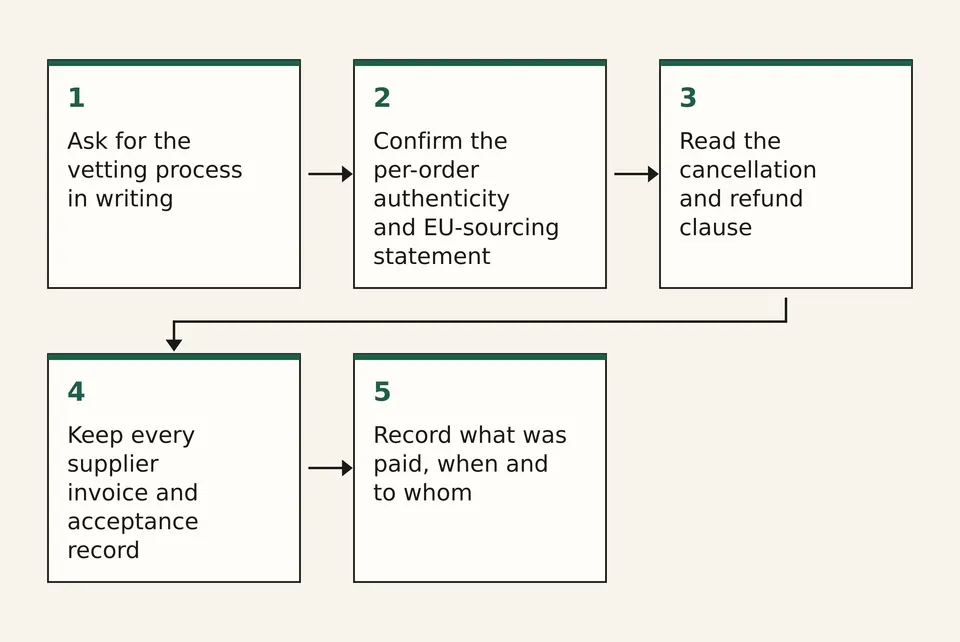
- Ask for the vetting process in writing. Include the Atradius wording and who the cover protects.
- Confirm the per-order authenticity and EU-sourcing statement. Ask whether it is given for each order or as a general statement.
- Read the cancellation and refund clause, including the notice period and any exclusions.
- Keep every supplier invoice and acceptance record. An Amazon staff reply in a seller forum, dated 20 September 2023, said that for a counterfeit-related violation the seller “will need to provide an invoice from where you purchased the items from your supplier”5.
- Record what was paid, when and to whom, so that any refund or dispute claim can be proven.
What money is at risk if an order is cancelled?
The Terms say that “Payment is generally made in advance at the time of order” and that all payments are processed through the platform3. A purchase order does not proceed until the seller accepts it, and acceptance or rejection must be communicated within one business day3.

If an accepted order is cancelled in its entirety, the seller must notify the buyer within three business days and refund all amounts paid in connection with the order, including any directly incurred expenses and the platform’s commission3. If an accepted order is not fully paid, the seller may cancel it within ten business days, and any partial payment must be refunded within fourteen calendar days3.
The Terms also say that once payment has been made, orders may not be cancelled or modified3. The text available to us is cut off at that point, so the full wording should be read in the Terms and Conditions before you pay.
Illustrative only: a buyer prepays €1,000 for an order and the seller cancels it in full after accepting it7. Under the full-cancellation clause, the buyer would be owed the full €1,000 back, including any commission3. Non-delivery or cancellation is a different case from fake goods. For goods of inappropriate quality, the Terms say the seller is “solely responsible to buyers for supplying goods and (or) services of appropriate quality”3.
Where do platform checks stop?
The Terms say the company “does not guarantee product or service quality”3. The FAQ says the platform “acts as an arbitrage marketplace platform and does not issue product certification or authentication documents”7.
Whether any given supplier is accepted, and whether a marketplace accepts a seller's invoices, is decided by that marketplace's own policies.
Two points remain unconfirmed. The FAQ asks “What is a processing fee?”7, but the answer was not visible to us, so no amount is given here. The vetting statements above are the platform's own description, and we have not found an independent check of them. Its About page quotes “Selected 5-star reviews” from Trustpilot6; reading the full, unselected Trustpilot page is a practical way to check how the platform performs.
Buyers are the importers of record. The FAQ says that “you act as the importer of record” and that you are responsible for import VAT and customs duties7. Questions on VAT, customs or product compliance should go to a qualified tax or legal adviser. This article gives general information only.
What to check before the first prepayment
- Ask in writing whose loss any insurance covers. The Atradius pages checked describe cover for unpaid invoices owed to businesses that sell on credit1,4.
- Get the vetting process, the per-order authenticity statement and the cancellation clause in writing before paying.
- Work out how much is at risk on the order itself, including refund conditions and any deadlines for claims.
- Keep every invoice and acceptance record, so that any claim can be documented.
Questions readers ask
Does Atradius insurance on a supplier page protect the buyer?
The Atradius pages checked describe cover for unpaid debts owed to businesses that sell on credit. Neither page says the cover pays a buyer who receives counterfeit, missing or incorrect goods1,4.
What should a buyer ask a marketplace before prepaying?
Ask whether every supplier is checked with Atradius, who carries out onboarding, whether the authenticity statement is given per order, and how counterfeit complaints are escalated2.
What happens to my money if an accepted order is cancelled?
If an accepted order is cancelled in full, the seller must notify the buyer within three business days and refund all amounts paid, including expenses and commissions3.