

Walmart’s US third-party marketplace grew nearly 50% year over year in the quarter ending 30 April 20264. On published fees and our illustrative figures, joining a big-box marketplace adds profit only when it reaches buyers a seller would not otherwise have reached. Whether the channel pays therefore depends on how many of its buyers are new.
What is actually growing, and what is still unknown?
Most of the sources here are written for brands, agencies or software users, not for Walmart or Target’s own sellers. Modern Retail’s reporting is aimed at brands and agencies1, and the Target Plus fee and returns details come from a third-party guide rather than Target’s own terms6.
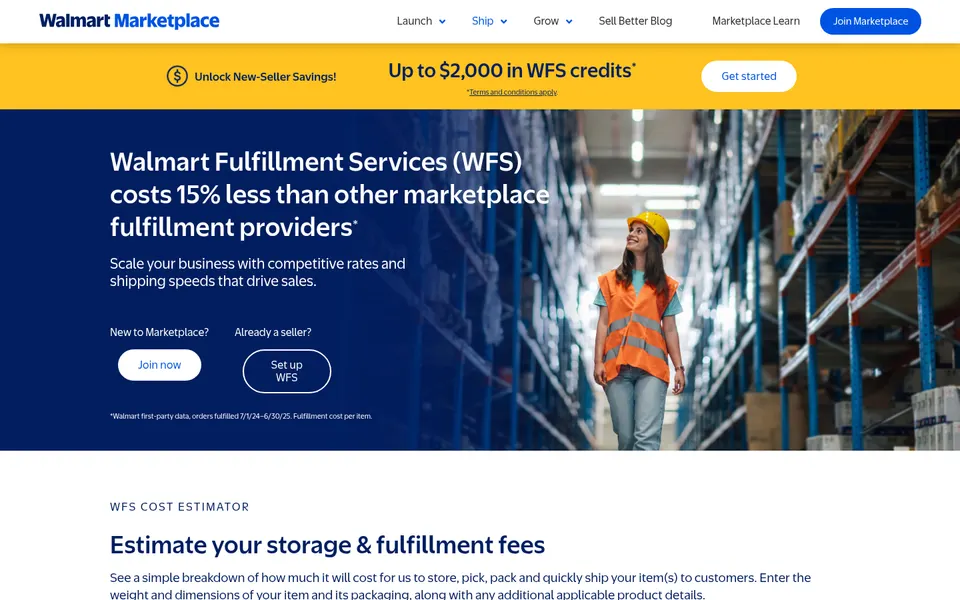
Walmart’s US third-party marketplace grew nearly 50% year over year in the quarter ending 30 April 2026, its fastest pace in years, according to Marketplace Pulse4. Units shipped same-day or next-day through Walmart Fulfillment Services (WFS), the service in which Walmart stores, picks, packs and ships seller stock, grew nearly 150% in the same quarter4. Marketplace Pulse estimates marketplace GMV (gross merchandise value, the total value of goods sold) at roughly $15 billion, around 10% of Walmart’s $150 billion US e-commerce business4.
On 4 March 2025, Target Corporation said its ongoing investments would aim to drive “billions of dollars of profitable sales growth across its multi-channel business by 2030”5. Target wants its marketplace, Target Plus, to become a $5 billion business by 2030 and is focusing on recruiting brands to it1.
Target Plus is invite-only, and Target does not publish its commission table6. Our analysis: growth in marketplace sales shows that buyers are arriving on these sites. It does not show whether a given seller’s sales are new.
How do the fee schedules look on paper?
Walmart charges a referral fee, which is “a percentage of the gross sales of each product sold”2. The rate depends on the item’s contract category, and sellers can find their rate in the commission rate column of the Statements page2. Total sales price includes shipping and handling, so the rate can depend on more than the item price2.
Rates vary sharply by category and price band. Apparel and accessories are charged 5% for items with a total sales price of $15 or less, 10% between $15 and $20, and 15% above $202. Jewellery and precious metals are charged 20% on the portion up to $250 and 5% on the portion above $2502. Home, Kitchen, Decor & Garden is charged 15%2.
WFS charges by shipping weight. An item weighing 2 lb costs $4.95, 3 lb costs $5.45, and 4 to 20 lb costs $5.75 plus $0.40 for each lb over 43. Walmart adds 0.25 lb for packaging and rounds up to the nearest pound3. Apparel adds $0.50 per item, and items priced under $10 add $13.
Walmart’s WFS page lists up to $2,000 in WFS credits under New-Seller Savings, with terms and conditions that apply3. Treat these as a conditional offer, not a permanent cost reduction.
Target Plus charges no setup or monthly fee and takes a referral commission on each sale6. Seller guides report that commission at 5% to 15% depending on category, but Target does not publish that table, so the range is unverified6. Sellers also pay their own shipping, returns and integration costs6.
What does one unit really earn?
The following is illustrative arithmetic, not sourced data. Every input is an assumption chosen to show how the costs stack up. The 15% referral rate matches the Home, Kitchen rate cited above2, and the 3 lb WFS fee is used for a 2 lb item because packaging takes it to 2.25 lb, which rounds up3.
Assumed inputs for a $40 item:3
- WFS fee, 2 lb item rounded to the 3 lb tier: $5.453
| Line item (per $40 unit) | Big-box marketplace (assumed inputs) | Own site (assumed inputs) | Notes |
|---|---|---|---|
| Fulfilment and shipping | $5.45 | $5.45 | WFS 3 lb tier3 vs self-shipping assumed to match |
The gap is not a verdict on marketplaces. It shows the extra buyers a marketplace must bring to match the own-site result.
What do storage and holding costs add?
WFS includes inventory storage for under 365 days with no minimums or maximums3. Items stored for more than 12 months may incur a fee of $2.25 per cubic foot per month, and additional fees apply for storage during peak season, 1 October to 31 December3. The WFS page does not give the peak-season amount in the material we reviewed.
Walmart’s WFS costs also exclude return processing fees and long-term storage fees3. Sellers who hold stock for the fourth quarter must therefore budget for those costs separately.
Holding stock is a judgement call. Gorilla Commerce’s chief executive, CJ Bilangino, described keeping inventory at the right level as a “Goldilocks situation”: too much stock risks excess storage fees on Amazon or Walmart fulfilment, and too little risks running out at key moments1. His company stages inventory with a network of third-party logistics (3PL) providers near Walmart and Amazon warehouses1.
What this means: does a marketplace sale add profit?
The result depends on how much the two audiences overlap. A seller whose own site already converts well with the same shoppers should expect most marketplace sales to be switched sales.
A simplified order cycle shows where the costs arise. The steps are illustrative and not taken from a source:
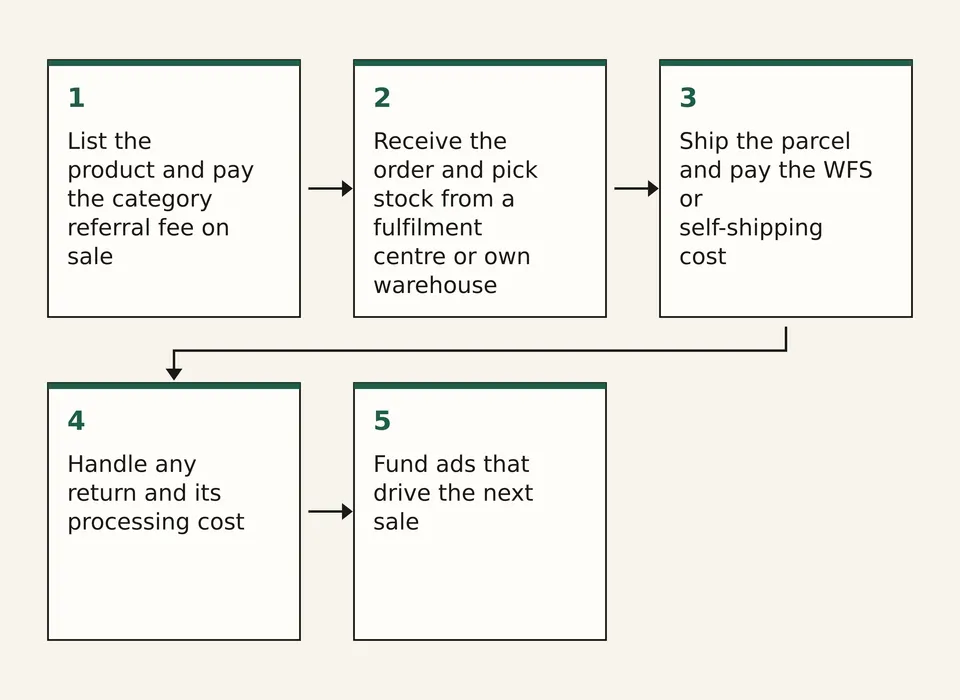
- List the product and pay the category referral fee on sale.
- Receive the order and pick stock from a fulfilment centre or own warehouse.
- Ship the parcel and pay the WFS or self-shipping cost.
- Handle any return and its processing cost.
- Fund ads that drive the next sale.
Operational load matters too. With the exception of Walmart and Amazon, most marketplaces still do not offer their own fulfilment services1. A seller with a single warehouse may need additional 3PLs to meet regional shipping, and Tinuiti’s Elizabeth Marsten said that is “when the economics of a marketplace can start to get challenging”1. She also said: “The business of returns is this massive cost that we don’t talk enough about”1. Target Plus sellers must accept returns and cover return costs, and a third-party guide reports a 30-day return window for most unopened items6.
Our view on who is likely to benefit: sellers with spare margin, multi-warehouse fulfilment and products not already priced aggressively on their own site are the strongest candidates. Low-margin or heavy products, single-warehouse sellers, and sellers whose holiday stock is already committed elsewhere are likely to struggle. One brand reports that Target does not want items over $5001. Monil Kothari of Haus of Brilliance said “Target doesn’t want anything over $500”1, so higher-priced items may need other channels.
Diversification helps spread risk without eliminating it. Haus of Brilliance still gets about 15–20% of its business from Amazon and now also sells through Target and Nordstrom1.
What should sellers watch next?
- Walmart’s next earnings update. Watch whether marketplace growth holds and whether WFS same-day and next-day volume keeps pace with listings4.
- WFS rates. Walmart says its fees are “subject to change”3, and the pricing page in our copy is dated March 20263. Check it before setting prices.
- Walmart’s advertising costs. Third-party advertising spend rose more than 50% as sellers competed for visibility4. Track cost per sale, not just spend.
- Target Plus access and progress. Watch whether Target moves toward its $5 billion goal1 and whether it opens invitations beyond its invite-only route6.
- Your own channel. Compare repeat-purchase rate and blended margin across channels, not just marketplace revenue, to see whether sales are new or switched.
Questions readers ask
How much is Walmart's referral fee?
Walmart charges a percentage of gross sales, and the rate depends on the item's contract category2. Examples in the article range from 5% for low-priced apparel to 20% on jewellery up to $2502.
Does Target Plus charge a monthly fee?
Target Plus charges no setup or monthly fee and takes a referral commission on each sale6. Target does not publish its commission table, so the 5% to 15% range reported by seller guides is unverified6.
What costs does WFS not cover?
WFS costs exclude return processing fees and long-term storage fees3. Items stored more than 12 months may incur $2.25 per cubic foot per month, and peak-season storage fees also apply3.
When does a marketplace sale add profit?
A marketplace sale adds profit only when it reaches buyers a seller would not otherwise have reached. A seller whose own site already converts well with the same shoppers should expect most marketplace sales to be switched sales4.
Sources
- Big-Box Briefing: How brands are juggling new marketplaces this holiday season Primary source
- Referral fee schedule for contract categories
- Walmart Fulfillment Services pricing
- Walmart Marketplace Growth Reaches Fastest Pace in Years
- Target Announces Strategic Plans to Drive More Than $15 Billion in Sales Growth by 2030
- Selling on Target Plus: Fees, How to Start and FAQ