

Amazon said on 20 October 2026 that it is hiring more than 300,000 people for seasonal, part-time and full-time roles across its US core operations network for the 2026 holiday season1. The announcement is about pay and benefits. It does not mention seller fees, FBA rates or inbound capacity. Seller-facing Q4 changes were published in July 20262, and they cover fees and deadlines rather than new capacity commitments.
What Amazon announced, and when
On 20 October 2026, Amazon said it "is hiring over 300,000 people for seasonal, part-time, and full-time roles across its U.S. core operations network nationwide this holiday season"1. Seasonal employees earn an average of $20 an hour, and full-time core operations employees start at a minimum of $20 an hour1.
Eligible seasonal employees, defined as those working at least 30 hours a week, will get healthcare coverage from their first day of work starting 1 January 20271. Seasonal employees hired before 1 January gain access on that date, and those hired on or after it have access from their first day1. New openings will be posted weekly from October through December1.
Who is affected
The release is aimed at the US core operations workforce that the hiring is meant to staff1.
Sellers are affected indirectly. Amazon's July seller guidance says "you may see lower capacity limits during this time," because fulfilment centres receive holiday stock in September and October, then shift to processing orders in November and December2. The 20 October release does not say how many of the new roles go to which sites, or whether they will change seller capacity.
Does the hiring change FBA fees?
No. The hiring release contains no fee change. The fee rules below come from Amazon's Seller Central post of 7 July 20262 and a Supply Chain Dive report on it3.
Holiday peak fulfilment fees apply from 15 October 2026 to 14 January 2027 for Fulfillment by Amazon (FBA), Remote Fulfillment with FBA, Multi-Channel Fulfillment and Buy with Prime2. Fees are calculated and charged when shipments leave fulfilment centres, so products shipped on or after 15 October pay the peak charges3. The peak increase over non-peak rates is the same as last year, averaging $0.32 per unit2.
Amazon's own examples show the size of the change by product type:
| Product (size tier) | Non-peak fee | Peak fee |
|---|---|---|
| Mobile device case (small standard) | $2.49 | $2.683 |
| T-shirt (large standard) | $6.14 | $6.53 |
| Baby cot (small bulky) | $10.21 | $11.25 |
| TV (extra large, 50–70 lbs) | $48.57 | $51.38 |
Source for table: Amazon, as reproduced in3.
A 3.5% fuel and logistics-related surcharge applies on top of the peak fees2. Amazon began levying it in April 20263. Asked when it will expire, an Amazon representative said it "will remain in effect until further notice"3. Amazon's source does not say what base the 3.5% is calculated on2.
Check your own rates in the Revenue Calculator, because your size tier and weight determine the real fee.
Will delivery times or capacity change?
Amazon has not published a delivery-speed figure for the 2026 holiday period1,2. Its delivery-related advice is to bring inventory in early to "ensure Prime delivery speeds for Black Friday and Cyber Monday orders"3.
Seller-specific capacity is not public. Sellers can use Capacity Manager "to bid for extra space" in fulfilment centres2. Whether the new hires offset the warning of lower capacity limits is not known.


How should a seller plan Q4 inbound and stock placement?
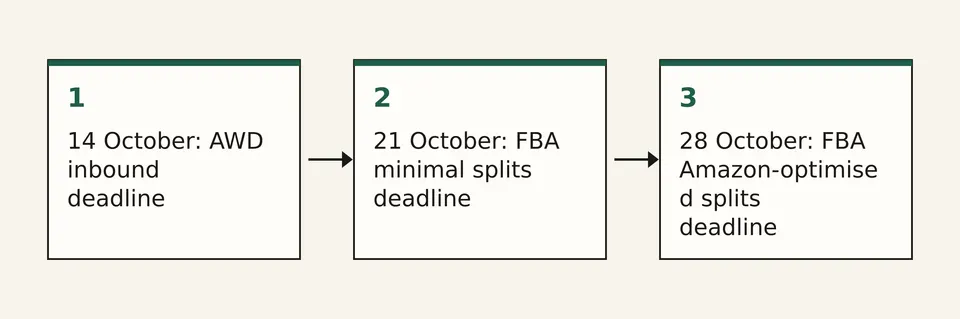
Amazon's published inbound deadlines for Black Friday Week and Cyber Monday are 14 October for Amazon Warehousing and Distribution (AWD) shipments, 21 October for FBA shipments with the "minimal shipment splits" option, and 28 October for FBA shipments with the "Amazon-optimized shipment splits" option, which Amazon says most sellers choose2. Amazon says these dates ensure Prime-badge eligibility for products during the events2.
- 14 October: AWD inbound deadline
- 21 October: FBA minimal splits deadline
- 28 October: FBA Amazon-optimised splits deadline
Amazon also says that sellers who send inventory through AWD and enable automatic replenishment to FBA keep paying the off-peak monthly storage rate through 31 October 20262.
Our view on the timing: as of 25 October 2026, the AWD and minimal-split deadlines have passed. Only the Amazon-optimised split deadline of 28 October remains, three days away. The off-peak AWD storage rate also ends on 31 October. Confirm the status of each shipment in Seller Central now, and check Capacity Manager for any space you need before peak. Use the Revenue Calculator, the Profit Analytics dashboard and the Fee and Economics Preview Report to compare peak costs across fulfilment types. Amazon has made peak rates available in all three2.
What this means
The hiring is a labour story. For sellers, the cost and planning facts are the peak fee window, the surcharge and the inbound deadlines. Our reading, not a claim made by Amazon: sellers who ship late are the most likely to feel any capacity squeeze.
What is not yet known
- Whether the 300,000 hires will change Q4 delivery times or capacity limits. Amazon gives no delivery-speed figure.
- When the 3.5% fuel and logistics surcharge will end, since Amazon says only "until further notice2."
- Any seller-specific capacity allocations for Q4 2026.
Questions readers ask
Does Amazon's holiday hiring change FBA fees?
No. The 20 October hiring release contains no fee change, and the peak fee rules come from Amazon's 7 July 2026 Seller Central post and a Supply Chain Dive report on it1,2,3.
How much more do peak fees cost per unit?
Amazon says the peak increase over non-peak rates averages $0.32 per unit, the same as last year2. Amazon's examples range from $0.19 more for a small mobile case to $2.81 more for a 50 to 70 lb TV3.
When does the 3.5% surcharge end?
Amazon has not said. An Amazon representative told Supply Chain Dive it will remain in effect until further notice3.