
A small seller can test whether an InPost locker or pickup option reduces failed-delivery costs, but the published material does not show that it will. The per-parcel prices come from InPost's own pages, which are undated, and the cost-saving figures come from a company release that does not disclose parcel volumes or methodology. Checked on 25 October 2026, the test pays only if the failure and return cost you avoid on each shifted parcel is higher than the locker fee for that parcel.
Why does this question matter now?
The main demand signal is a survey of UK consumers reported on 21 October 2026. Research from InPost UK, the parcel carrier, found that 41% of 18–30-year-olds surveyed had missed a parcel delivery in the past 12 months, and almost half were away during 9am–5pm delivery hours at least four days a week1.
That is a carrier's research, reported by a secondary outlet, so treat it as a reason to test rather than proof for your own customers. A separate InPost release describes a different survey: a base of 2,018 consumers who had sent or received a parcel in the previous three months, run in July 2025 and hosted by Yonder Data Solutions2. Its "41%" refers to consumers who receive parcels via lockers, a different statistic from the missed-delivery figure above2.
The main retailer example is Superdry. InPost says its share of Superdry's checkout reached as high as 49% when InPost became Superdry's sole free delivery option, and that Superdry recorded up to a 19% reduction in total delivery cost1. The figures were released by InPost on 8 September 2026 and are based on data from the two companies6. InPost has not disclosed the underlying parcel volumes or detailed methodology, so the results are company-reported6. InPost lockers accounted for around 20% of Superdry's UK deliveries as of 30 April 20266.
Superdry's setup is not a like-for-like test of a small seller's options. When the ChannelX article was written, Superdry was offering three free delivery choices: free to an InPost Locker or Shop, free to home (or next day for £3.99), or free to collect in store1.
What does a locker or pickup option cost per parcel?
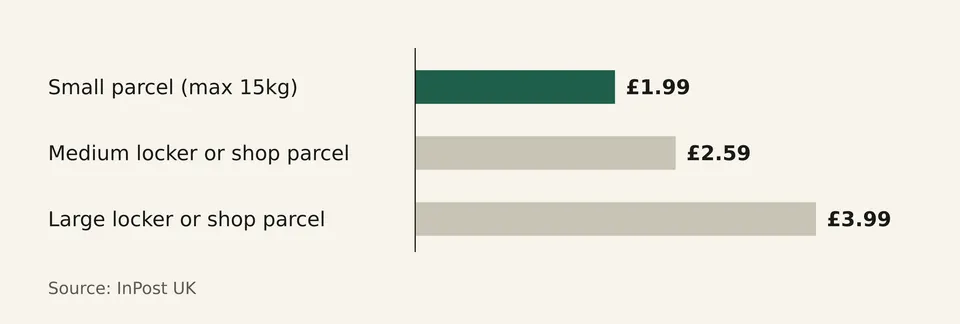
InPost's consumer send page lists £1.99 for a small parcel sent to an InPost Locker or Shop, £2.59 for a medium and £3.99 for a large, each with a 15kg maximum3. The same page lists £2.89, £3.99 and £5.99 for the same sizes sent to a home address3. The recipient then has 3 days to collect from a locker or shop3.
InPost Direct's locker-to-locker table lists a small parcel at 1.66 ex VAT, a medium at 2.16 ex VAT and a large at 3.32 ex VAT, for parcels up to 15kg sent through InPost Lockers4. The page does not show a currency symbol. Adding 20% to 1.66 gives 1.99, so the two small-parcel prices may be the same on different VAT bases1. This is our arithmetic and neither page confirms it.
Neither the InPost send page nor the InPost Direct page shows a date, and the send page does not say whether its prices apply to business accounts. Before comparing figures, record each page's address, the date you checked it and whether the price includes VAT.
The UPS Access Point page for an Indianapolis location lists drop-off times and locker opening hours, but no per-parcel prices, so it cannot be used as a price source for this test5.
How do you measure the cost of a failed delivery?
The baseline is the cost your current setup already incurs. Measure it before you offer any locker option, so the test has something to beat.
We recommend counting five things for your current carrier, one country and one product group:
- Failed or missed attempts per 100 parcels, over at least one full month.
- Any redelivery or return-to-depot charge from the carrier's current rate card.
- Your own handling time and customer-service contacts for each missed parcel, kept as a separate line from carrier charges.
- Returns per 100 parcels, recorded separately, because a locker may change refund behaviour as well as missed drops.
- The cost of each return, where your carrier charges for it.
InPost's release says lockers bring merchants "fewer failed drops, faster returns"2. That is a company claim, so the test should measure both failures and returns rather than assume either falls.
How should a small test be set up?
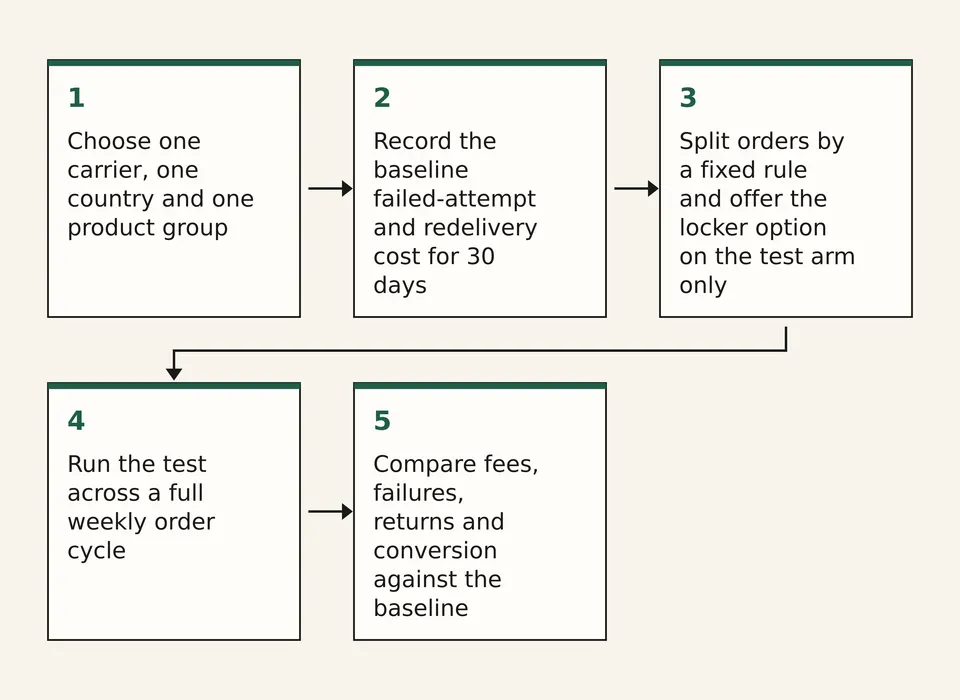
Run a controlled comparison rather than switching the whole shop to lockers. Limit the test to one carrier, one country and one product group, and keep the checkout price the same for both arms so the result reflects delivery behaviour rather than a price change.
- Choose one carrier, one country and one product group
- Record the baseline failed-attempt and redelivery cost for 30 days
- Split orders by a fixed rule and offer the locker option on the test arm only
- Run the test across a full weekly order cycle
- Compare fees, failures, returns and conversion against the baseline
Set the split rule and sample size before you start, such as alternate days or order-number parity. Changing the rule mid-test makes the result hard to read.
What does the arithmetic look like?
The following is illustrative, with invented numbers. It is not sourced and should be replaced with your own data.
The general rule: a shift to lockers saves money only when the failure cost avoided per shifted parcel, plus any return-cost saving, exceeds the locker fee on that parcel.
What should the test report?
Record the same metrics for both arms so the results can be compared and reproduced.
| Metric | Control arm (no locker option) | Test arm (locker option) | Source of figure | Date checked |
|---|---|---|---|---|
| Delivery fee paid per parcel, with VAT basis | Your carrier rate card | |||
| Failed attempts per 100 parcels | Carrier tracking data | |||
| Redelivery charges per 100 parcels | Carrier invoice | |||
| Return rate per 100 parcels, with reason codes | Your order and returns records | |||
| Checkout conversion | Your checkout analytics | |||
| Handling time and customer contacts per missed parcel | Your own time log and support tickets |
Keep the date of each rate card and the date you checked the rules in the test log, so the result can be reproduced.
Is it worth running? Our view
Yes, a small seller can test a locker or pickup option to cut failed-delivery costs. The sourced material does not show that the saving will happen for your customers, and the Superdry figures are company-reported without the parcel volumes or method behind them.
The locker fee for your carrier and country must be smaller than the failure and redelivery cost you avoid, as measured at baseline. If your failure rate is low, avoided failures will rarely cover a locker fee on the parcels you shift.
Re-check every rate card before you launch. The InPost send page and InPost Direct page were both retrieved on 25 October 2026 but neither shows a date, so the figures may have changed since then.
Questions readers ask
Does the published material show that lockers will cut failed deliveries for a small seller?
No. The sourced material does not show that the saving will happen for your customers, and the Superdry figures are company-reported without parcel volumes or method6.
What locker fee does InPost list for a small parcel?
InPost's consumer send page lists £1.99 for a small parcel sent to an InPost Locker or Shop, but the page is undated3. The InPost Direct table lists 1.66 ex VAT for a small parcel, and the currency symbol is not shown4.
What should a small seller measure before offering lockers?
Measure failed attempts per 100 parcels over at least one full month, redelivery charges, handling time, returns and the cost of each return, so the test has a baseline to beat2.
Which metrics should the test report for each arm?
Report delivery fee per parcel with VAT basis, failed attempts, redelivery charges, return rate with reason codes and checkout conversion, with the source and date of each figure.
Sources
- The 'Always Out Generation' - Young adults away from home most of the week Primary source
- Parcel lockers become the new favoured choice
- How much it costs to send with InPost (parcel price list)
- Locker To Locker
- UPS Access Point location at CVS, Indianapolis
- Superdry shoppers shift to InPost lockers, cutting delivery costs by up to 19%, InPost says