
Amazon's notices show that some 2026 UK fulfilment fees fall while storage and other charges rise2. A UK Amazon third-party (3P) seller who sells at full price still needs to check every line before concluding a unit is profitable. The cost inputs are placeholders, not published rates, so the walk-through shows which lines matter most rather than what any product earns. Figures were checked on 26 October 2026.
What the ChannelX article can and cannot show
The ChannelX piece, dated 26 October 2026, features Stanislav Yordanov, co-founder of Amazon Experts, an agency that runs more than 50 brands through its own seller accounts across the UK, US and Europe1. Its central claim is that 'in January a lot of that growth turns out to have cost more than it earned'1.
The article does not publish a per-unit cost stack, FBA rate, cost of goods or margin, so its claim cannot be tested from the piece alone1. Its only money figures come from one Italian body-care brand: branded campaigns spent €1,242.60 and brought in €51,068.95 in sales over July and August, while non-branded campaigns spent €1,474.83 for €22,614.931.
Our view: one brand's euro figures, with no unit margin, cannot tell a UK seller whether a UK unit is profitable. The article is more useful for its advice on measurement. It recommends watching TACoS (ad spend as a share of total sales) alongside ACoS, and notes that a deal costs more than the discount because of the deal fee and the margin given up on every unit1.
What Amazon has confirmed for UK fees
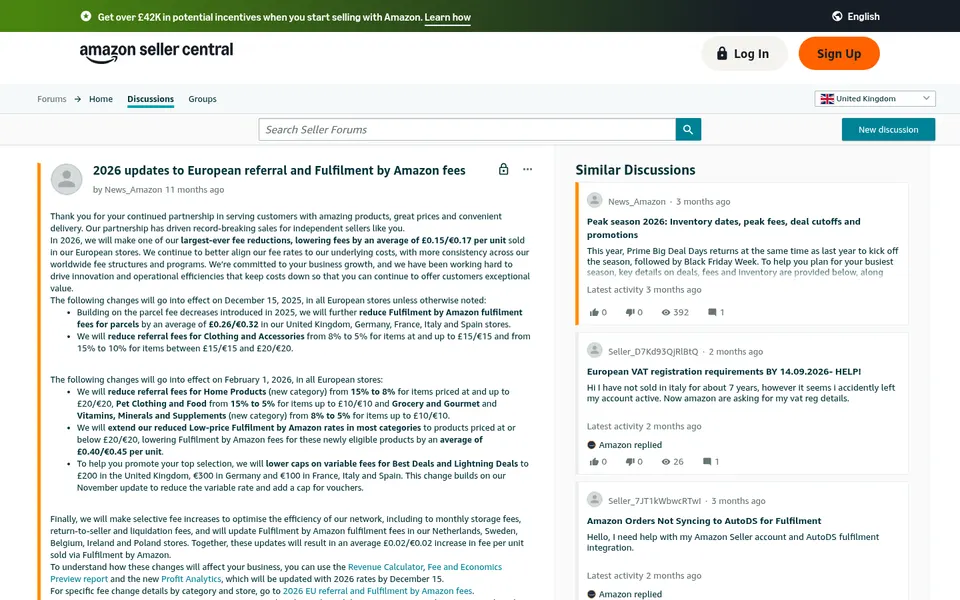
Amazon's notice posted on 2 December 2025 says UK Fulfilment by Amazon (FBA) parcel fees fall by an average of £0.26 from 15 December 20252. The same notice extends low-price FBA rates to products priced at or below £20 from 1 February 2026, lowering fees by an average of £0.40 per unit for newly eligible products2.
Selective increases to monthly storage, return-to-seller and liquidation fees net to an average £0.02 per unit2. The notice also caps variable fees for Best Deals and Lightning Deals at £200 in the UK2.
Amazon's July 2026 forum post sets the UK festive peak fee at an average of £0.12 per parcel item and £0.07 per large or extra-large envelope item, applying from 15 October 2026 to 14 January 20273. The fee does not apply to oversize or low-price FBA items3.
Referral fees depend on category, and most fall between 8% and 15%4. Amazon's UK pricing page lists a Professional plan at £25 excluding VAT per month and an Individual plan at £0.75 per unit sold4. Osome says the Individual plan suits sellers selling fewer than about 35 items a month and cannot use Sponsored Products5.
Which charges are still secondary-only
Amazon's July post says a 1.5% fuel and logistics-related surcharge applies on top of festive peak fulfilment fees3. We did not find that surcharge in a primary Amazon rate card for other periods, so confirm it in your own Fee Preview before relying on it for non-peak sales.
Storage is a gap in this review. Osome says the rate for many standard-size products roughly doubles from October to December5. We found no primary Amazon figure for the storage amounts used below.
Beauty, Health and Personal Care referral is 8% up to £10 and 15% above £10, with a £0.25 per-item minimum5. Osome states that referral fees are charged on the total sales price, including shipping and gift wrap5.
Illustrative unit walk-through: the full-price unit
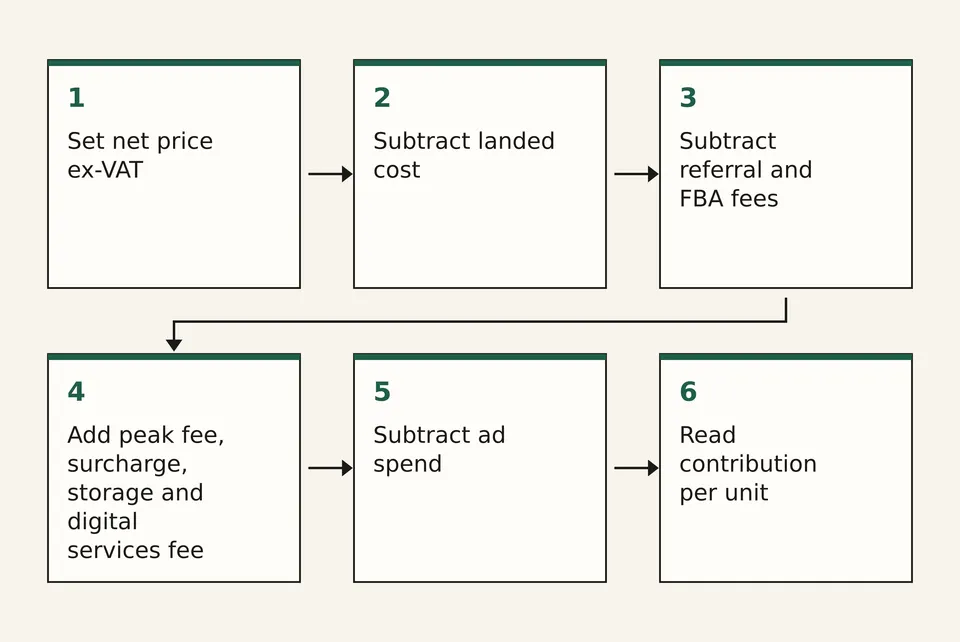
The walk-through uses these six steps, in order. Every input is a labelled placeholder except the £0.12 peak fee3.
- Set net price ex-VAT
- Subtract landed cost
- Subtract referral and FBA fees
- Add peak fee, surcharge and storage costs
- Subtract ad spend
- Read contribution per unit
The ad line assumes a Professional plan, because the Individual plan cannot use Sponsored Products5.
The 30% deal case
| Cost line | Base unit (£) | 30% deal unit (£) | Source status |
|---|---|---|---|
| Net price ex-VAT | 25.00 | 17.50 | Placeholder |
| Landed cost | 8.00 | 8.00 | Placeholder |
| Referral (15%) | 3.75 | 2.63 | Category range sourced4; 15% is a placeholder |
| FBA fee | 3.00 | 3.00 | Placeholder |
| Surcharge (1.5%) | 0.045 | 0.045 | Rate sourced3 for peak fees; base here is a placeholder |
| Peak fee | 0.12 | 0.12 | Sourced3 |
| Storage | 0.20 | 0.20 | Placeholder |
| Ads (20% of price) | 5.00 | 3.50 | Placeholder |
| Total cost | 20.12 | 17.50 | |
| Contribution | 4.88 | 0.00 |
The table excludes deal fees. Amazon's July post gives UK deal fees as an upfront £12 per promotion plus a 0.75% variable fee, capped at £6003. That cap conflicts with the £200 cap on Best Deals and Lightning Deals variable fees in Amazon's December notice2. We could not reconcile the two from these sources, so check your own Fee Preview before modelling a deal.
ChannelX warns that 'a week at 30% off resets what shoppers expect to pay,' and that a price increase afterwards can look like a price rise1.
Which cost line moves margin most
Our view, based on the illustrative arithmetic above:
- Discount depth is the largest lever. With ads held at 20% of the lower price, each percentage point of discount cuts contribution by about 16p on a £25 unit1.
- Ad ratio is second. At £25, each percentage point of ACoS costs £0.25 per unit1. Ad spend that stays flat while sales fall pushes the real cost up, which is why TACoS matters1.
- Landed cost and FBA set the floor. A unit that cannot cover them at full price will not be rescued by Q4 volume.
- The peak fee and storage are real but small on this unit. The £0.12 peak fee is under 0.5% of the £25 price3.
Scenarios: base, deal-led and stock-out


Deal-led: a 30% discount with ads at the same ratio is about break-even on the same stack1. Deal SKUs should pass a margin test before they go live.
Stock-out or aged stock: ChannelX says that running out of stock in December is 'the most expensive Q4 mistake,' because it loses peak sales and organic rank, and that winning rank back in January means 'more ad spend in a quieter market'1. No source in this review prices that cost. Model it from your own sales history.
Our view: if sales are flat while ad spend rises, the ads are probably buying sales you would have made anyway. That is the clearest warning sign in the TACoS argument1.
What to watch next
- 28 October 2026: Amazon's UK inbound date for Black Friday Week, for Prime-badge eligibility. Amazon gives 21 October 2026 for European facilities and 28 October 2026 for the UK3.
- 18 November 2026: the deadline to submit Black Friday Week deals3.
- 15 October 2026 to 14 January 2027: the festive peak fee window3. Confirm whether the 1.5% surcharge applies to your non-peak orders3.
- Deal fee caps: reconcile the £200 cap in Amazon's December 2025 notice2 with the £600 variable cap in its July 2026 post3.
- Your own numbers: Amazon's December notice refers to the Fee and Economics Preview report2. Use it to replace every placeholder in this walk-through.
Questions readers ask
Are the walk-through costs real UK Amazon rates?
No. Every input except the £0.12 peak fee is a labelled placeholder, so the walk-through shows which cost lines matter most rather than what any product earns3.
Which cost line affects margin most?
Discount depth is the largest lever in the illustrative arithmetic, with ad ratio second1. Each percentage point of discount cuts contribution by about 16p on a £25 unit1.
Does the festive peak fee apply to every item?
No. Amazon's July 2026 post says it does not apply to oversize or low-price FBA items3.
Is storage cost confirmed?
No. The review found no primary Amazon figure for storage amounts, so sellers should model storage from their own Fee Preview5.