

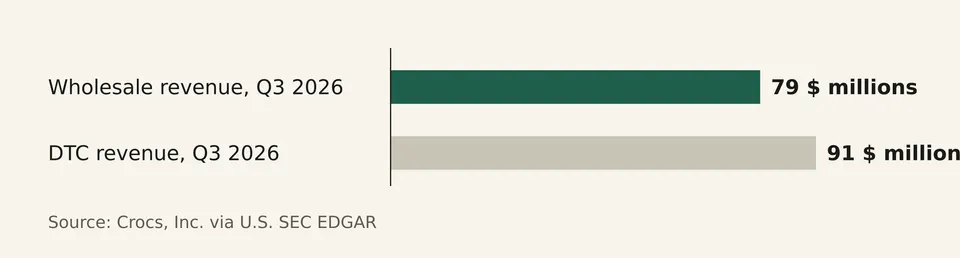
Crocs, Inc. reported on 29 October 2026 that HEYDUDE revenue rose 6.1% to $170 million in the third quarter, with wholesale sales to retail partners up 14.0% to $79 million and direct-to-consumer (DTC, sales made straight to shoppers) up 0.1% to $91 million2. The published figures do not show unit volumes, selling prices or margin by channel, so they cannot settle whether a wholesale unit earns more than a DTC unit. This article sets out what the filings do show, then works through a per-unit test using assumptions we label as illustrative.
What the published numbers can and cannot answer
Crocs reports HEYDUDE revenue split between wholesale and DTC2. It also reports a brand-level gross margin: HEYDUDE's adjusted gross margin was 45.8%, up 350 basis points (a basis point is one-hundredth of a percentage point)3. That figure blends both channels.
The sources are written for investors. The press release, the earnings call and the analyst commentary discuss revenue growth, margins and guidance, not the terms a small brand would be offered by a retailer1,2,3.
What HEYDUDE's Q3 2026 figures show
HEYDUDE's third-quarter revenue of $170 million was up 6.1%2. Crocs chief executive Andrew Rees acknowledged that the topline boost was measured against weak results a year earlier1. Crocs said that for the full year 2026 it expects HEYDUDE revenue to be approximately flat compared with 20252.
Using the growth rates in the release, the same share was roughly 43% a year earlier (our arithmetic on the S2 figures)2.
Crocs said the wholesale growth came from higher at-once and replenishment orders as retail partners restocked inventory3. Rees described wholesale as a "more cost-effective way to reach our intended consumer" and said the brand is unlikely to open many more stores1. HEYDUDE had 75 stores at the end of March 2026, up from 54 a year earlier, according to Crocs' annual report1.
On the DTC side, HEYDUDE revenue rose only 0.1%2. Crocs said the brand reduced promotional activity to focus on full-price selling and higher average selling prices3. That is the nearest the results come to a comment on DTC price per unit.
How a wholesale unit and a DTC unit compare: an illustrative test
The numbers below are not HEYDUDE data. They are a simple model with invented inputs, so the logic can be tested. The retail price is set at twice the wholesale price, in line with the keystone rule, a common retail convention in which the retail price is double the cost. Femfounded says a product cost of around a quarter of retail leaves room for both the brand's and the retailer's margin4.
ILLUSTRATIVE assumptions: a $100 DTC price; a $50 wholesale price, so the retailer sells at $100; and a $25 landed cost (the total cost of the unit once delivered)2.
| Line (ILLUSTRATIVE) | DTC unit | Wholesale unit |
|---|---|---|
| Price received by brand | $100 (shopper pays) | $50 (retailer pays)2 |
| Landed cost | $25 | $25 |
| Gross profit per unit | $75 | $25 |
| Channel costs assumed | $35 (fulfilment, payments, paid acquisition) | $5 (freight, markdown and return allowances) |
| Contribution per unit | $40 | $20 |
On these inputs, a wholesale unit wins only when DTC channel costs exceed wholesale channel costs by more than $50, because wholesale gross profit is $50 lower than DTC gross profit ($25 against $75)1. Here the gap is $30, so DTC wins per unit2.
A wholesale unit can still be worth more in total if it sells many more units against a fixed cost base. The filings do not quantify that trade-off for HEYDUDE.
Our analysis: restocking, markdowns and the blended margin
This is our interpretation, not reported fact.
The wholesale growth in the quarter came from restocking3. If retailer inventories normalise, that demand may fall back. The first test is HEYDUDE's fourth-quarter guidance: revenue up 10% to 12% compared with the fourth quarter of 20252.
The 45.8% HEYDUDE margin is a blend2. Crocs attributed the increase to lower tariffs and improved product mix3. Because the channel split is not published, a stronger blended margin could coexist with weaker wholesale margins, or the reverse.
Mix is moving toward wholesale. With DTC flat and promotions reduced3, a rising wholesale share could mean a lower average revenue per unit across the brand, if wholesale prices sit below DTC prices. The company has not confirmed that link for HEYDUDE, so treat it as a hypothesis.
What a small brand should take from this
We recommend running your own version of the test before accepting any wholesale deal:
- Model DTC cost per order in full, including shipping, payment fees, returns and any paid advertising.
- Get the wholesale allowance terms in writing, including markdown support and return rules, and add them to the wholesale cost line.
- Estimate the return rate you can realistically expect and apply it to both channels.
- Compare total contribution at realistic volumes, not per unit alone. A deal that adds volume can still reduce profit if its costs absorb the margin.
For a worked version of a unit-profit check, see UK Amazon sellers: a six-line check for full-price unit profit.
What to watch next
- HEYDUDE fourth-quarter revenue against the 10% to 12% guidance2.
- Any channel-level margin or unit disclosure from Crocs, which would allow a direct test of the per-unit question.
- Wording on wholesale pricing and channel mix in future filings, to see whether the third-quarter pattern repeats.
- Tariff refunds. Crocs received $64 million in refunds in the quarter, which it describes as non-recurring3.
- Crocs' North American shift from DTC to wholesale. On the Crocs brand, the company cites a 270 basis point headwind to North American revenue from the business model shift3. Whether HEYDUDE follows the same path is a question for future results.
Questions readers ask
Did HEYDUDE's wholesale sales grow faster than its DTC sales?
Yes. Wholesale sales rose 14.0% to $79 million, while DTC sales rose 0.1% to $91 million in the third quarter2.
Can the filings show which channel earns more per unit?
No. The published figures do not show unit volumes, selling prices or margin by channel, so the per-unit question cannot be settled from them2.
What drove the wholesale growth?
Crocs said higher at-once and replenishment orders as retail partners restocked inventory drove the growth3.
What should a small brand check before accepting a wholesale deal?
The article recommends modelling full DTC cost per order, getting allowance and return terms in writing, and comparing total contribution at realistic volumes rather than per unit alone4.
Sources
- Heydude wants to sell more in North America, but is unlikely to open new stores Primary source
- Crocs, Inc. Reports Strong Third Quarter 2026 Results; Raises Full-Year 2026 Outlook (Exhibit 99.1 to Form 8-K)
- Crocs (CROX) Q3 2026 Earnings Call Transcript
- Keystone Pricing: The Retail Rule of Doubling - Femfounded