
Intake Breathing, a Southern California-based maker of a patented nasal dilator system, has taken a $62 million investment from Camino Partners, reported on 28 October 20261,2. The money is meant to fund retail expansion and internal hiring, but none of the reporting discloses profit, margins or retail terms1,2.
Our reading: the only profitability figures in the sources (revenue and EBITDA) come from an incumbent's acquisition, and they do not transfer to a small seller.
What the $62M round does and does not tell sellers
Camino Partners is a firm founded by Daniel Lubetzky, the Kind Snacks founder1. Glossy reports that the $62 million will buy out early friends-and-family investors, grow a staff of 35 people, diversify marketing and enter big-box retail2.
Intake currently sells through its own direct-to-consumer (DTC) website and on Amazon1. Modern Retail reports that the brand is preparing to enter mass retail1.
Co-founder and CEO Alex Hauck said Intake has had triple-digit growth over the past three years and has sold more than 100 million pairs of breathing tabs since its launch1. Glossy reports that annual sales are approaching $100 million2. Neither article reports an independent check of these figures.
Investor evidence for the category rests on one statistic. Elle Lanning, president of Camino Partners, said: "When we looked at it in the data, 74% of Intake consumers have not been legacy category consumers"1. The reporting does not describe how that figure was measured.
Our reading: the round shows that an investor is willing to back nasal wellness products. It does not show whether Intake makes money on each unit.
Why the reported numbers do not yet reconcile
The sources give different launch dates. Glossy says the company launched in 20182. Modern Retail ties the 100 million pair count to a launch in 20231. Readers should not build a sales history until the company confirms which date is correct.
The unit is also undefined. The sources do not say what Intake counts as a "pair", and the 100 million figure is cumulative since launch while the sales figure is annual, so the two cannot be checked against each other.
The only profitability benchmark belongs to an incumbent
Prestige Consumer Healthcare's filing, dated 20 March 2026, agreed to acquire a portfolio of brands with approximately $200 million of revenue and $95 million of EBITDA for the twelve months ended 31 December 20254. Breathe Right accounts for about two-thirds of that portfolio's revenue and profitability4. Prestige describes Breathe Right as having "strong margins and cash flow generation"4.
EBITDA, earnings before interest, taxes, depreciation and amortisation, is a non-GAAP measure, meaning it is not a standard accounting figure4. That is a portfolio-level ratio for an established brand, not a benchmark for a new seller.
What a customer pays per night
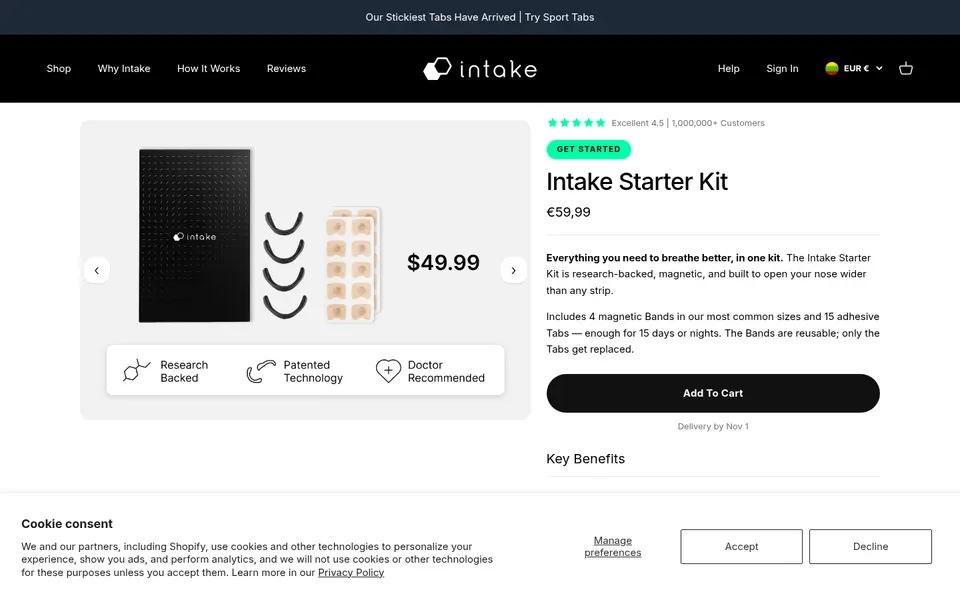
The Intake starter kit costs $49 and includes 15 sets of magnetic adhesive strips for 15 days or nights of wear2. The kit includes four sizes of the nasal dilator2. The Intake product page is titled "Intake Premier Nasal Dilator Starter Kit"3.
The strips are single-use2. Glossy reports that the device's most common use case is sleep, because it can help temper snoring by reducing mouth breathing2.
The sources include no refill price or subscription terms, so this article does not model a repeat-purchase plan.
Product evidence: what a skeptical buyer should weigh
The only regulator record in the sources is one voluntary report in the US Food and Drug Administration (FDA) MAUDE database, which collects reports of adverse events involving medical devices5. The event date is 25 November 2024, and the report was made on 27 November 20245. A 29-year-old male patient reported that he "Wore the nose band as directed, and had skin irritation and developed a rash"5.
The performance claims come from the company. Hauck said consumers report better daily activity and sleep patterns due to optimized breathing1. The sources do not include an independent trial of effectiveness.
One report does not show how often irritation happens. It is still a documented problem, and skin tolerance and adhesion bear on refunds and repeat orders.
What this means for sellers
The following is our analysis, based on the sourced facts above. It is not a finding from any source.
Retail: more volume, with margins and operations to manage
Retail can add volume, but a retailer takes its own margin, and the seller also carries promotional and freight costs. Hauck said Intake is investing in "product unification, SKU management and having our operations dialed in and ready for the size orders that come with retail"1. For a small seller, that operational load can be heavier than the sales gain.


Direct sales and subscriptions: full price, but retention decides it
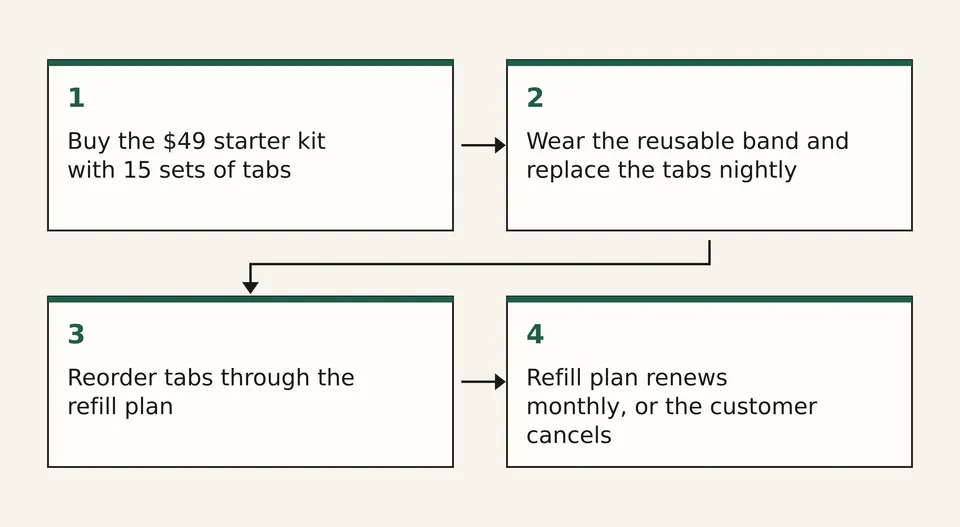
A DTC seller keeps the full price of each sale without a retailer's margin. Its profit then depends on what it spends to acquire each customer and how often customers reorder. The diagram shows a generic refill model, not a verified Intake process. Skin irritation and adhesion problems matter most here, because a product that customers stop wearing or return will not support repeat orders. Readers modelling a subscription should use their own acquisition, return and reorder assumptions. For channel fee comparisons, see our coverage of Walmart and Target marketplace fees.
A small brand without scale: a hard route into shelf space
Breathe Right holds the leading US position in the nasal strip category, according to Prestige4. It is sold in drug and mass stores2. A small brand competing for the same aisles would face an incumbent with distribution and shelf presence. Our view is that a niche subscription, or a specific use case such as sleep or sport, is a more practical route than chasing shelf space.
It is one incumbent's figure for a multi-brand portfolio, and the sources do not show what costs sit beneath it.
What to watch next
- Retail partners: which retailers Intake signs, and whether its strips reach drug or mass shelves, as Modern Retail reports the brand is preparing for1.
- Company metrics: whether Intake publishes retention, repeat-purchase or subscription figures, and defines what a "pair" is.
- Incumbent results: Prestige expects the Breathe Right acquisition to close during the first half of its fiscal 20274. Its later reporting on the brand would show whether the category is growing at the incumbent level.
- Safety reports: further MAUDE reports on skin irritation from Intake strips. The FDA database page we checked on 28 October 2026 was last updated on 30 September 20265.
Questions readers ask
How much did Intake Breathing raise?
Intake Breathing took a $62 million investment from Camino Partners, reported on 28 October 20261,2. The money is meant to fund retail expansion and internal hiring1,2.
Do the sources show Intake's profit margins?
No. None of the reporting discloses profit, margins or retail terms1,2. The only profitability figures in the sources come from Prestige's acquisition of a broader portfolio4.
Sources
- Intake Breathing nabs $62M investment, joining the emerging nasal wellness trend Primary source
- Can Intake turn optimized breathing into a wellness status symbol? Camino Partners is betting on it
- Intake Premier Nasal Dilator Starter Kit - Life Changing Breathing
- Prestige Consumer Healthcare Announces Agreement to Acquire Breathe Right
- MAUDE Adverse Event Report: INTAKE BREATHING TECHNOLOGY LLC. INTAKE NASAL STRIP; DILATOR, NASAL