

Oddly Profitable: eBay Q3 2026 and what the take rate does not tell sellers
eBay's third-quarter 2026 results, published 28 October 2026, do not report a take rate, meaning the share of sales value the platform keeps as revenue. What a seller pays on each eBay sale follows the fee schedule eBay publishes separately2.
What did eBay report for Q3 2026?
The release and the call transcript are written for investors. The fee pages are written for sellers, and the Depop calculator is aimed at resellers, so the figures below answer different questions.
The quarter ended 30 September 20261. Revenue was $3.2 billion, up 14% as reported and 13% on an FX-neutral basis, meaning growth with currency movements removed1. GMV was $23.2 billion, up 15% as reported and 16% FX-neutral1. Advertising revenue was $607 million, and the GAAP (standard accounting basis) operating margin was 19.2%1.
eBay Live, its live-selling format, had a record quarter and is generating GMV at a multibillion-dollar annualised run rate, with growth “well into the triple digits year over year”1. The Motley Fool's transcript of the call puts Live growth above 100%4.
The release gives no take-rate figure1. Any take-rate number therefore comes from our own arithmetic, shown below.
Why a platform take rate is not a seller fee rate
In this article, take rate means revenue divided by GMV. The difference is roughly 0.16 percentage points, which sits within the rounding of the reported growth rate1.
The ratio is a platform measure. It shows how much eBay books per dollar of total volume. It does not show what a given seller pays on a given sale. The release reports advertising revenue separately, so the platform figure is not a seller-fee figure alone1. Advertising was $607 million of $23.2 billion GMV, or about 2.62% of GMV in our arithmetic1.
What does the Q4 2026 guidance suggest?
eBay guided fourth-quarter revenue to $3.19 billion–$3.24 billion, with 5% to 7% organic FX-neutral growth, and GMV to $23.7 billion–$24.1 billion4.
That would be a further step down from the Q3 figure. It is our estimate from guidance, not a reported number.
On the call, Chief Financial Officer Peggy Alford said Depop is “operating at a lower take rate than our core marketplace,” which the transcript says is expected to pressure the consolidated take rate until the acquisition anniversary is reached4. The transcript does not quantify that effect.
What do eBay's published fee rules say?
For most categories, eBay charges one final value fee when an item sells. It is 13.6% of the total sale amount up to $7,500 per item and 2.35% on the portion above $7,5002. A per-order fee is added: $0.30 for orders of $10.00 or less and $0.40 for orders over $10.002. The total sale amount includes the item price, handling, shipping collected from the buyer, sales tax and other applicable fees2.
Other categories have different rates. Books & Magazines pays 15.3% up to $7,500 per item2. Jewelry & Watches, excluding watch parts and accessories, pays 15% up to $5,000 and 9% above that2.
eBay Live sales have different fees from standard listings, and the help page points to a separate Live fee page2. The page we reviewed does not state the Live rates, so this article does not calculate Live net.
How do you work out a seller's net on one eBay sale?
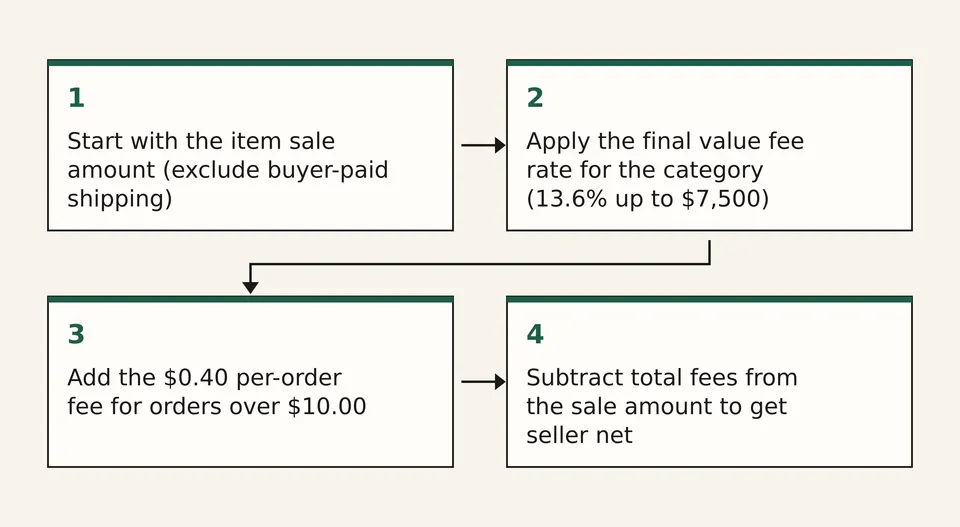
For a standard sale in a most-categories listing, these four steps give the seller's net.


- Start with the total sale amount: the item price, plus any shipping and handling you collect from the buyer, plus sales tax2
- Apply the final value fee rate for the category (13.6% up to $7,500)2
- Add the $0.40 per-order fee for orders over $10.002
- Subtract total fees from the sale amount to get seller net
The worked examples below use the item price only, so they understate fees if you charge shipping or tax.
Is Depop cheaper, and what is the catch?
For US sellers, the third-party ResellerIndex calculator, which is not run by Depop, reports no Depop selling fee and a payment processing fee of 3.3% plus $0.453. The processing fee applies to the item price, shipping and any tax3.
The calculator says it last read Depop's rates on 14 October 2026 and that Depop's own page is the authority3. We could not check Depop's help page for this article, so treat these rates as unverified until you have done so.
The calculator says a sale through a Boosted Listing adds 12%3. For new US and UK listings from 23 March 2026, the boost fee is 12% of the item price, and it applies only when a buyer interacts with the boosted listing and buys within 28 days3. Depop's page does not say which rate applies to listings created before that date3. On a $50 item, the boost fee alone is $6.00, nearly three times the processing fee1.
Etsy's filing, as reported by the calculator, says Etsy completed the sale of Depop to eBay Inc. on 30 July 2026 and received about $1.4 billion in cash at closing3. The filing announces no change to what Depop charges sellers3. The call transcript reports Depop's US GMV more than doubled year over year on a pro forma basis4. The release says Depop is “offering more affordable shipping options in the U.S.” without giving fee details1.
Illustrative net on one sale across channels
The table uses the rates cited above. All rows are our arithmetic, not reported results, and each excludes product cost, returns and subscriptions.
What this means for sellers
Analysis: the blended take rate is not your cost. A stable platform ratio says little about your net, because it can hold steady while the mix shifts. If advertising grows as a share of GMV, marketplace fees per sale could fall without changing the total. The release does not show which of these happened1.
Our scenarios use the illustrative arithmetic above.
- High-ticket seller. Items above $7,500 pay 2.35% on the portion above that point, so the effective rate falls as price rises2.
- Depop seller. A payment-only model looks cheaper on paper, but one boosted sale of $50 adds $6.00 in boost fees1.
We recommend building a separate fee sheet for each channel from your own invoices. Include shipping, returns, promotions and any subscription. Check eBay's Live fee page before modelling Live sales.
Watch these items next:
- eBay's Q4 2026 results against the guidance of $3.19 billion–$3.24 billion revenue and $23.7 billion–$24.1 billion GMV4.
- Any change to Depop's processing or boost fees, or to the 12% boost rate1.
- The Live fee rates, once you have checked them on eBay's Live page2.
- Advertising's share of GMV, which shows whether the platform ratio is being held up by advertising.
For a similar per-unit method on another marketplace, see UK Amazon sellers: a six-line check for full-price unit profit.
Questions readers ask
Does eBay report a take rate for Q3 2026?
No. The release gives no take-rate figure, so any take-rate number in the article comes from our own arithmetic, dividing revenue by GMV1.
How is a seller's net on one eBay sale worked out?
Start with the total sale amount, including item price, shipping and sales tax. Apply the 13.6% final value fee up to $7,500, then add the $0.40 per-order fee for orders over $10.002.
Is Depop cheaper for sellers?
A third-party calculator reports no Depop selling fee and a 3.3% plus $0.45 processing fee for US sellers, but these rates are unverified against Depop's own page. Boosted sales add a 12% fee3.
Why is advertising relevant to seller fees?
Advertising revenue is reported separately, so a platform ratio that includes it is not a seller-fee figure alone. Advertising was about 2.62% of GMV in our arithmetic1.