

A price gap for the same branded product between two EU countries survives the costs of buying, shipping and reselling only if it still exists after VAT is removed, marketplace commission is deducted and delivery is added. This guide sets out a five-step check to run before paying.
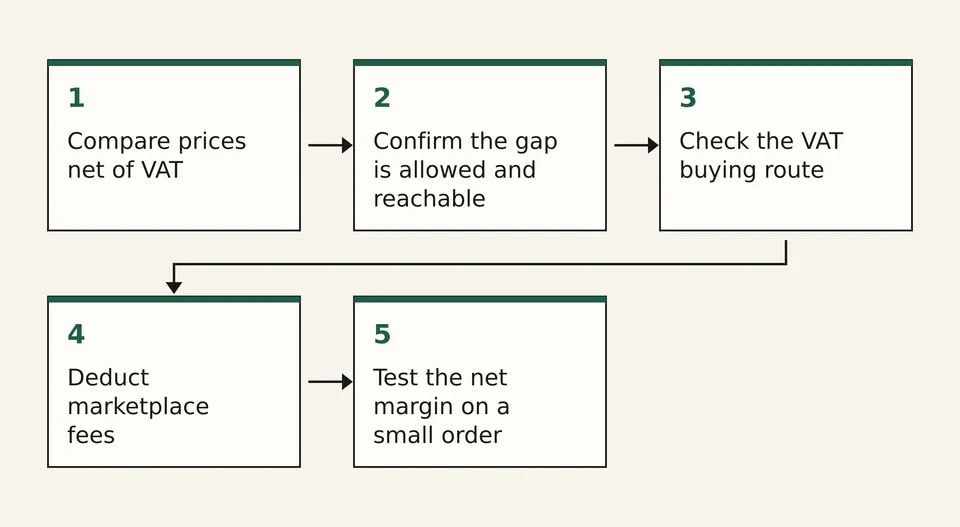
The check has five steps:
- Compare prices net of VAT
- Confirm the gap is allowed and reachable
- Check the VAT buying route
- Deduct marketplace fees
- Test the net margin on a small order
Why compare net of VAT instead of the gross shelf price?
Compare net prices first, because VAT rates differ between EU countries. Eurofiscalis gives the 2026 standard rates as 17% in Luxembourg, the lowest, and 27% in Hungary, the highest3. Germany is 19%, and Spain and the Netherlands are 21%3. Eurofiscalis says its table was checked on 28 September 2026 against the European Commission and national tax authorities3. Confirm rates against official national sources before relying on them.
Illustrative arithmetic: at the 19% German rate and the 27% Hungarian rate listed in3, a 100 euro gross price is about 84.03 euros net and about 78.74 euros net respectively, a difference of about 5.29 euros from tax alone.
Working rule: convert both countries' prices to net of VAT before calculating any gap. For goods shipped between EU countries, the place of taxation of an intra-Community acquisition is where the goods are finally located after dispatch1.
Is the gap allowed, and can you reach the other market?
Before treating a gap as usable, confirm that you can buy the lower-priced version at all, including whether the supplier's webshop and terms accept buyers in your country.
Wholesale prices are visible only after sign-up, so this step cannot be finished from public pages2. The public starting point is the retail range on eany.io, which shows retail prices across EU countries next to wholesale prices for its catalogue2. Eany has a 300 euro minimum for the whole order, with no minimum per supplier, and includes delivery to EU addresses in the price, with one invoice covering all suppliers in the order2. Eany is free to join and takes about a minute to open an account; it needs a VAT number but no card2.
The retail range shows where a gap may exist. The signed-in wholesale price, the VAT treatment and the delivered cost decide whether the gap is usable.
Which buying route keeps the VAT treatment valid?
For sales to businesses, Eurofiscalis lists intra-Community supplies as exempt3. For sales to private consumers, the place of taxation of intra-Community distance sales is where dispatch or transport to the customer ends1. A supplier's intra-Community distance sales below EUR 10,000 in a calendar year are taxed where dispatch or transport begins, although the supplier may opt to follow the normal rules1. Above 10,000 euros, Eurofiscalis says you charge the customer's country rate and report it through the OSS3. Check this before selling cross-border to consumers.
Confirm that your VAT number is valid and that the invoice shows the treatment you expect. This guide does not cover the rules for each country, so ask a tax adviser about your position.
What do marketplace fees take out of the gap?
Commission is the share a marketplace keeps from each sale. The worked example below uses an estimated 15%, which varies by marketplace and category2.
Illustrative arithmetic: on a 50 euro net sale, commission is 7.50 euros at 15% and 10.00 euros at 20%2.
Eany's example applies the 15% estimate to the price including VAT, so 15% of 50.72 euros is 7.61 euros2. Confirm which price your marketplace uses as the commission base, and record the rate and the date you checked it.
Platform figures in this guide come from the platform's own pages and have not been checked independently. The marketplace decides how it applies its own fees and rules.
Does the net margin survive a small test order?
A margin example published by a wholesale platform, with prices tracked on 15 October 2026, is for a sale in Spain: a selling price of 50.72 euros including 21% VAT, or 41.92 euros excluding VAT2. After an estimated 15% commission of 7.61 euros and a delivered price of 19.75 euros excluding VAT, it leaves 14.56 euros per unit, or 34.7%2. The example excludes fulfilment, payment and the seller's own costs2.
Under the platform's terms dated 24 September 2026, payment is generally made in advance at the time of order, and once payment has been made, orders may not be cancelled4. A test order therefore carries cash at risk from the start. Run a small test order that records every cost line, including commission, delivery, packing and any returns, and compare the result with the net margin before scaling up.
What this means
A price gap is worth testing only after it survives every step in this check.
This guide covers published EU VAT rules and the platform figures cited above. It does not compare marketplaces, and it does not give tax advice.
Questions readers ask
Why should the price comparison be made net of VAT?
VAT rates differ between EU countries, so gross shelf prices can mislead. Eurofiscalis lists 17% in Luxembourg and 27% in Hungary for 2026, so both countries' prices should be converted to net before calculating any gap3.
How can a reseller confirm a price gap is reachable?
Public retail ranges show where a gap may exist, but wholesale prices are visible only after sign-up, so the signed-in wholesale price and delivered cost must be checked before the gap is treated as usable2.
Does selling to consumers across borders change the VAT treatment?
Yes. Sales to private consumers are taxed where dispatch or transport ends, and below 10,000 euros a year a supplier may follow the origin rules, while above 10,000 euros the customer's country rate applies through the OSS1,3.
What should a test order record before scaling up?
A test order should record every cost line, including commission, delivery, packing and returns, and be compared with the net margin before scaling up. Platform terms generally require advance payment, and paid orders may not be cancelled, so cash is at risk from the start4.